Understanding Radon: The Invisible Health Hazard in Homes and Buildings
Radon is one of the most common—yet least understood—environmental health hazards found in residential homes and commercial buildings. Because you cannot see, smell, or taste it, radon often goes unnoticed until a home inspection or testing kit reveals its presence.
Below is an overview of what radon is, where it comes from, how it enters structures, its impact on human health, and how it can be effectively mitigated.
1. Radon Basics: Where Does It Come From?
At its simplest, radon is a naturally occurring radioactive gas.
The Geology Behind Radon
- Natural Breakdown: Deep within the earth, trace amounts of uranium naturally exist in soil, rock, and water. Over time, uranium decays into radium, which then breaks down into radon gas.
- Geographical Variance: While radon exists everywhere across the globe, certain regions have higher concentrations of uranium in their bedrock (such as granite, shale, and phosphate), leading to higher local potential for radon generation.
- Outdoor vs. Indoor: Outdoors, radon gas rapidly dilutes in ambient air to safe, negligible levels. However, when radon gas rises through the ground and becomes trapped inside an enclosed space like a home, school, or office, it can accumulate to hazardous concentrations.
2. The Mechanics of Radon Entry: How Radon Gets Inside
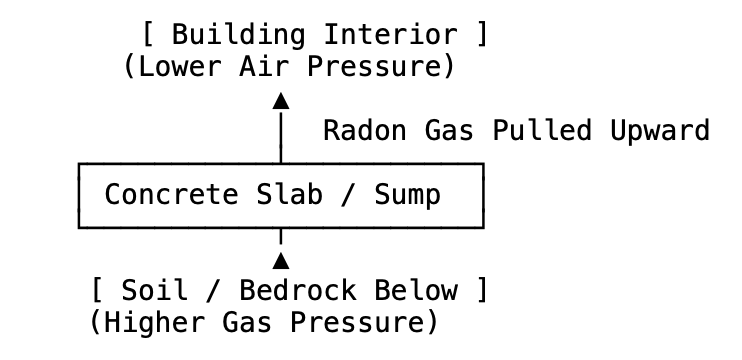
To understand how radon enters a building, it helps to think of a structure as a giant vacuum pulling air out of the ground.
The Stack Effect & Soil Depressurization
Buildings experience a phenomenon known as the stack effect (or chimney effect). Warm air inside the building rises and escapes through upper floors, attics, and exhaust vents. This upward movement creates a negative pressure differential at the base of the building—essentially creating a slight suction against the soil.
Because air and soil gases naturally move from areas of high pressure (the ground) to low pressure (the interior of a basement or slab-on-grade), radon is drawn into the structure through various entry pathways:
- Cracks in Foundation Slabs & Walls: Unsealed stress cracks, cold joints, and expansion joints in poured concrete.
- Construction Joints: Gaps where the concrete floor slab meets the foundation wall (perimeter cracks or "floating slab" gaps).
- Pipelining & Utility Penetrations: Unsealed openings around plumbing, electrical conduits, and drain lines passing through the floor or walls.
- Sump Pits and Floor Drains: Open pits or unsealed drains that lead directly into the sub-slab aggregate.
- Hollow Block Walls: Void spaces inside concrete masonry unit (CMU) walls that allow soil gas to migrate upward and vent into living areas.
- Well Water (Secondary Source): In homes supplied by groundwater wells, radon dissolved in water can off-gas into indoor air when water is used for showering, laundry, or dishwashing.
3. Health Impacts: How Radon Affects Human Health
Radon is classified as a Class A Human Carcinogen by the U.S. Environmental Protection Agency (EPA) and the World Health Organization (WHO). It is the leading cause of lung cancer among non-smokers and the second leading cause overall.
Biological Mechanism of Exposure
Radon gas itself is relatively inert; however, it rapidly decays into short-lived radioactive particles known as Radon Decay Products (RDPs) or "radon daughters" (polonium-218 and polonium-214).

- Inhalation & Deposition: When inhaled, these solid RDP particles attach to the delicate epithelial lining of the pulmonary tissue and bronchial tubes.
- Alpha Decay: As RDPs undergo further decay, they release alpha particles—high-energy, short-range ionizing radiation.
- Cellular and DNA Damage: Alpha particles do not travel far, but they pack substantial kinetic energy. They strike the DNA of adjacent lung cells, causing single- and double-strand DNA breaks.
- Oncogenesis: While the body can repair some cellular damage, repeated radiation strikes over time can result in genetic mutations, uncoordinated cellular replication, and ultimately the formation of malignant lung tumors.
Risk Factor Amplification: The combined risk of lung cancer from radon exposure and tobacco smoking is synergistic—meaning a smoker exposed to high levels of radon has a dramatically higher risk of developing lung cancer than a non-smoker exposed to the same levels.
4. Testing and Exposure Thresholds
Because radon levels fluctuate due to barometric pressure, soil moisture, heating/cooling usage, and seasonal changes, testing is the only definitive method to assess risk.
- Measurement Units: In the U.S., radon is measured in picocuries per liter of air (pCi/L). Globally, it is measured in Becquerels per cubic meter (\text{Bq/m}^3). (1 pCi/L ≈ 37 \text{Bq/m}^3).
- EPA Action Level: The EPA recommends taking action to mitigate homes with radon levels at or above 4.0 pCi/L. However, the EPA also notes that radon risks exist below this level, and reduction down to 2.0 pCi/L or lower is often achievable.
5. Radon Mitigation: Engineering Controls and Remediation
Fortunately, almost any building—regardless of age, structural design, or radon concentration—can be successfully mitigated. Radon mitigation techniques aim to either prevent radon from entering or remove it before it reaches living spaces.
Primary Active Mitigation Methods
A. Active Soil Depressurization (ASD)
ASD is the most effective and commonly installed mitigation system in residential and commercial properties.
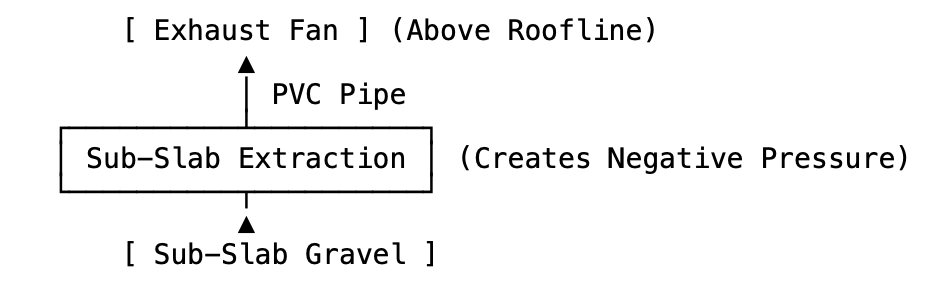
- Mechanism: A suction pit is created beneath the concrete slab or vapor barrier. A specialized inline radon fan continuously draws air and soil gases from under the foundation through a closed PVC pipe system and vents it safely above the roofline, where it dilutes into the atmosphere.
- Pressure Inversion: By keeping the air pressure beneath the slab lower than the air pressure inside the building, the flow of soil gas is reversed—radon is sucked into the pipe rather than into the living area.
B. Sub-Membrane Depressurization (Crawl Space Applications)
For homes with open soil or gravel crawl spaces:
- A heavy-duty, high-density polyethylene vapor barrier (retarder) is laid over the floor and continuously sealed to the foundation walls.
- A suction pipe is routed beneath this membrane to draw out soil gas before it can escape into the crawl space and structure above.
C. Building Pressurization & Mechanical Ventilation
In some commercial buildings or specific structural types, adjusting the HVAC system to maintain slight positive air pressure inside the building relative to the soil can prevent radon ingress. Energy Recovery Ventilators (ERVs) can also be utilized to increase fresh outdoor air exchange, diluting indoor radon concentrations.
D. Sealing Entry Routes (Secondary Control)
Sealing floor cracks, sump basin tops, and expansion joints is a critical secondary measure. While sealing alone is rarely sufficient to lower high radon levels significantly, it improves the energy efficiency and suction field capability of an ASD system.
Summary & Next Steps
- Radon is natural: It originates from decaying uranium in soil and rock.
- Radon accumulates: Buildings act as low-pressure vacuums that draw gas in through foundation pathways.
- Radon is hazardous: Inhaled radioactive decay products damage lung tissue and significantly increase lung cancer risk.
- Radon is solvable: Active soil depressurization systems reliably reduce indoor radon concentrations to safe levels.
Need Assistance with Radon Testing or Building Diagnostics?
At Building Science Advisors, our team applies proven diagnostic procedures, building envelope analysis, and indoor air quality protocols to ensure your indoor environments remain safe, healthy, and compliant. Contact our experts today to schedule a consultation or diagnostic evaluation.

