Understanding Air Filtration in High-Performance Buildings
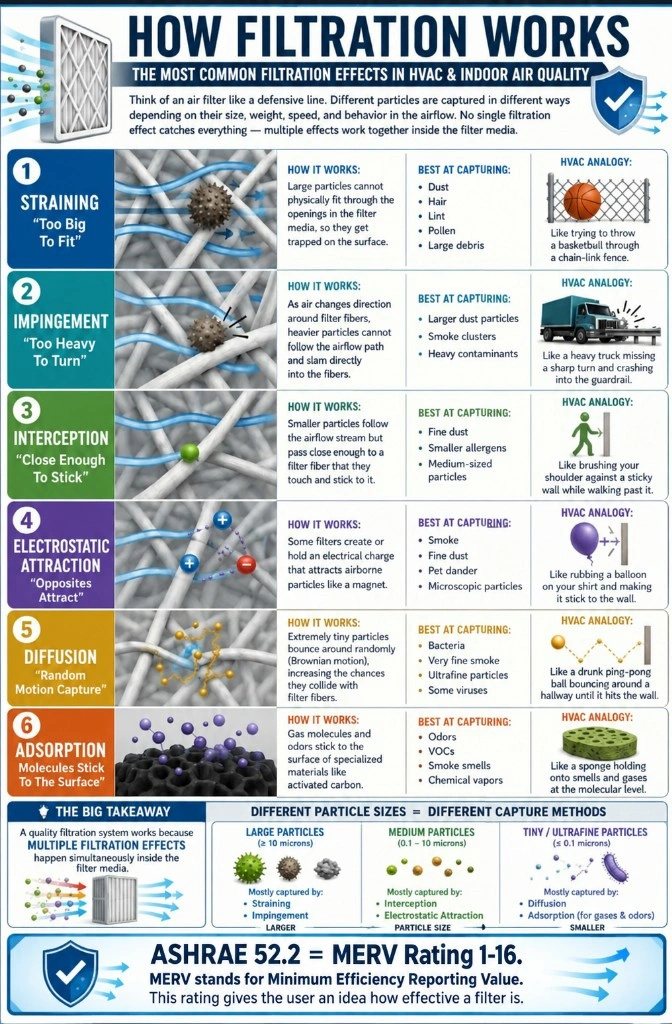
Air filtration is one of the most vital—yet frequently misunderstood—components of indoor air quality (IAQ) and HVAC system performance. Whether you are designing a high-efficiency residential home, retrofitting a commercial property, or trying to understand the air quality in your own living space, understanding the science of filtration is essential to creating healthy, durable, and energy-efficient environments.
1. Why Filtration Matters: The Science of Indoor Air Quality (IAQ)
Buildings today are built tighter than ever before to conserve energy. While airtight construction prevents unconditioned air, moisture, and outdoor pollutants from leaking through building enclosures, it also traps indoor-generated pollutants inside unless properly managed.
Particulate matter (PM) poses a significant risk to human health and building mechanical systems. Indoor air contaminants typically fall into three categories:
- Coarse Particles (PM10): Dust, pollen, mold spores, and dust mite debris (2.5 to 10 microns).
- Fine Particles (PM2.5): Combustion particles, organic compounds, and fine dust (0.1 to 2.5 microns).
- Ultrafine Particles (PM0.1): Viruses, fresh smoke, and auto emissions (<0.1 microns).
Effective filtration traps these particles before they circulate through living spaces or accumulate on sensitive HVAC machinery like cooling coils and blower motors.
2. Decoding Filter Ratings: MERV, HEPA, and Beyond
Not all filters are created equal. In building science, performance is quantified by standardized testing methodologies.
Minimum Efficiency Reporting Value (MERV)
Developed by ASHRAE (Standard 52.2), MERV rates a filter’s ability to capture particles between 0.3 and 10 microns in size. Higher MERV ratings indicate a higher percentage of trapped particles:
- MERV 1–4: Basic protection. Captures large particles (>10 µm) like lint and carpet fibers. Primary role is protecting equipment, not human health.
- MERV 5–8: Standard residential filters. Captures mold spores, dust mites, and pet dander (3.0 to 10 µm).
- MERV 9–12: Superior residential and light commercial. Captures fine dust, auto emissions, and lead dust (1.0 to 3.0 µm).
- MERV 13–16: High-performance residential and hospital-grade. Captures bacteria, smoke, and droplet nuclei carrying viruses (0.3 to 1.0 µm). MERV 13 is the recommended baseline for modern healthy building standards.
HEPA (High-Efficiency Particulate Air)
True HEPA filters are tested to trap at least 99.97% of particles down to 0.3 microns. Because of their high resistance to airflow, HEPA filters are rarely installed directly inside standard central HVAC duct systems without dedicated bypass fans or specialized equipment.
3. The Building Science Trade-Off: Efficiency vs. Pressure Drop
One of the core tenets of building science is that every component affects the whole system.
As a filter’s efficiency increases (higher MERV rating), its media density often increases, creating greater resistance to airflow—known in building science as static pressure drop.
Higher MERV Rating ➔ Tighter Media ➔ Increased Static Pressure Drop ➔ Reduced Airflow (if unmanaged)
Potential Risks of Unmanaged Static Pressure:
- Reduced Airflow: Causes comfort issues, cold or hot spots, and inadequate ventilation.
- HVAC Wear and Tear: Blower motors work harder, increasing energy consumption and premature failure rates.
- Coil Freezing: Reduced airflow across cooling coils can cause thermal expansion issues and freeze evaporator coils in summer.
- Bypass Air: High resistance can force unfiltered air through tiny gaps around the filter rack, defeating the filter's purpose entirely.
The Solution: Deep-Pleated Filters
To achieve high filtration (MERV 13+) without strangling your HVAC system, increase the surface area of the filter media. Replacing a standard 1-inch filter with a 4-inch or 5-inch deep-pleated filter drastically reduces airflow resistance while significantly extending filter lifespan.
4. Key Filtration Strategies for Homes and Commercial Buildings
At Building Science Advisors, we recommend a holistic, multi-layered approach to indoor air management:
- Source Control (First Line of Defense): Eliminate or reduce pollutant sources (e.g., zero-VOC materials, sealed combustion appliances, proper exhaust hoods).
- Central System Filtration: Upgrade central air handlers to accommodate 4-inch to 5-inch deep MERV 13 filters with properly sealed filter racks.
- Balanced Mechanical Ventilation: Integrate Energy Recovery Ventilators (ERVs) or Heat Recovery Ventilators (HRVs) equipped with outdoor air intake filters to bring in clean, fresh air.
- Supplemental / Portable HEPA Units: Utilize standalone HEPA air purifiers in high-occupancy areas or bedroom zones for targeted particle reduction.
- Gas-Phase Filtration: Use activated carbon filters where volatile organic compounds (VOCs), odors, or ozone are primary concerns.
5. Maintenance and System Design Best Practices
To ensure maximum performance and energy efficiency over time, consider these practical rules of thumb:
- Seal Filter Housing: Ensure air cannot bypass the edges of the filter. Frame seals (or gasketed filter tracks) are critical.
- Monitor Pressure Drop: Install a static pressure gauge or differential pressure switch to know exactly when a filter needs changing based on resistance rather than a calendar date.
- Avoid Thin High-MERV Filters: Do not place 1-inch MERV 13 filters into standard air handlers unless the duct system has been specifically engineered to handle the increased static pressure.
- Schedule Routine Maintenance: Inspect filters every 30 to 90 days, replacing or cleaning according to manufacturer guidelines and pressure readings.
Need Guidance on Indoor Air Quality or HVAC Design?
Balancing filtration performance, ventilation rates, and energy efficiency requires system-level engineering. Whether you are troubleshooting air quality issues, retrofitting a mechanical system, or aiming for high-performance building certification, Building Science Advisors is here to help.