A systems-level IAQ investigation identified the root cause of recurring tenant health complaints after three rounds of standard remediation had failed to resolve the issue — preventing escalating legal exposure for the owner.
.png)
Whether you're evaluating a vendor proposal, investigating recurring building issues, planning a capital project, or assessing a new acquisition, we'll help determine the right next step.
This narrative describes a common engagement pattern in IAQ complaint investigations. It is presented as a representative scenario illustrating the diagnostic and legal protection value of a systems-level investigation. Specific client and property details are confidential.
A multifamily property management team had received escalating IAQ complaints from tenants across multiple units over an extended period. Standard remediation had been performed twice. The complaints had not resolved. Tenant legal action was being threatened. The ownership group engaged Building Science Advisors for an independent investigation.
Tenant-reported symptoms including respiratory irritation, odor complaints, and general air quality concerns. IAQ sampling had been conducted by a prior assessor and had identified elevated mold spore counts. The remediation performed in response had treated the visible contamination. The complaints had returned.
Recurring IAQ complaints after remediation create compounding legal exposure. Each remediation cycle that fails to resolve the complaint strengthens a tenant’s habitability claim — demonstrating that the owner was aware of the problem, took action, and the action failed. Continued failure after multiple remediation cycles suggests either inadequate scope or, more damaging, that the root cause was never identified. The financial exposure from unresolved IAQ litigation in a multifamily building extends well beyond remediation costs.
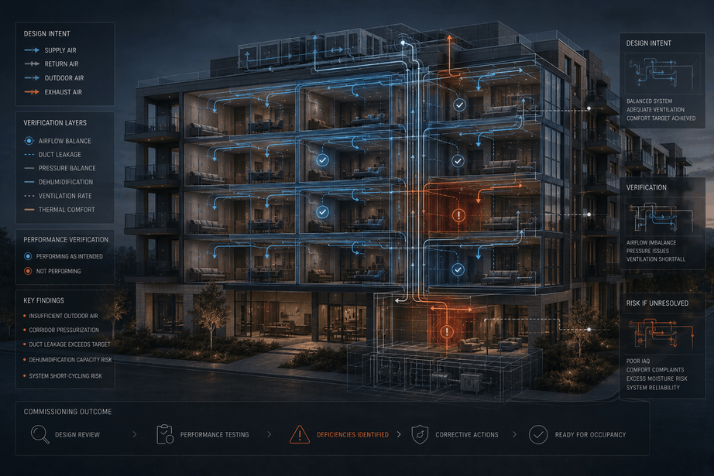
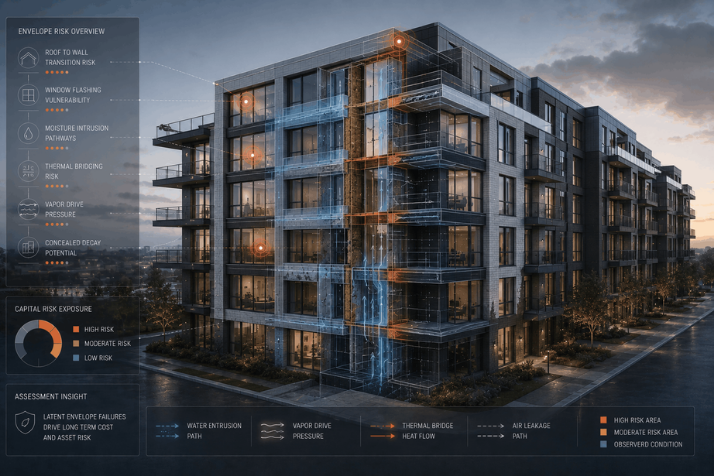
Building Science Advisors conducted a comprehensive systems-level investigation combining IAQ sampling with building science diagnostics. This included GrayWolf IAQ measurement of particulates, CO2, VOCs, and bioaerosols; blower door testing and air pressure mapping across affected units and corridors; HVAC system performance assessment including airflow, static pressure, and ventilation rates; moisture investigation including relative humidity mapping, dew point analysis, and thermal imaging; and building envelope assessment of the zones adjacent to the complaint units.
Standard IAQ investigations identify what is present. They do not identify why it is present. An elevated spore count tells you contamination exists — it does not tell you whether the source is the HVAC system, the building envelope, the duct system, or a moisture condition in the wall assembly. Without that root cause finding, any remediation is directed at the symptom. The symptom returns because the cause remains.
The investigation identified the mechanism driving the recurring contamination. The Corrective Action List specified the targeted interventions required to eliminate the cause — not the symptom — and defined the clearance protocol by which the outcome would be verified. The protocol specified that clearance testing be performed by an independent party with no relationship to the remediator. This is the standard the building industry refers to as not having the fox guard the henhouse — and it is one of the most commonly violated standards in IAQ remediation.
Post-corrective commissioning and clearance testing confirmed that the conditions driving the IAQ complaints had been eliminated. Building Science Advisors produced a commissioning record and clearance documentation suitable for tenant communication, property management files, and legal defense. The engagement was not considered complete until the clearance was confirmed by an independent third party.
Recurring IAQ failures are almost always diagnosis failures, not remediation failures. The remediator cleaned what they could see. Nobody identified why the contamination kept returning. A systems-level investigation that finds the cause — and a corrective scope that addresses it — breaks the cycle. The documentation produced by that investigation also provides the owner with a defensible record in any legal proceeding that follows.
Contact Building Science Advisors to discuss an IAQ investigation or building science assessment for your asset.