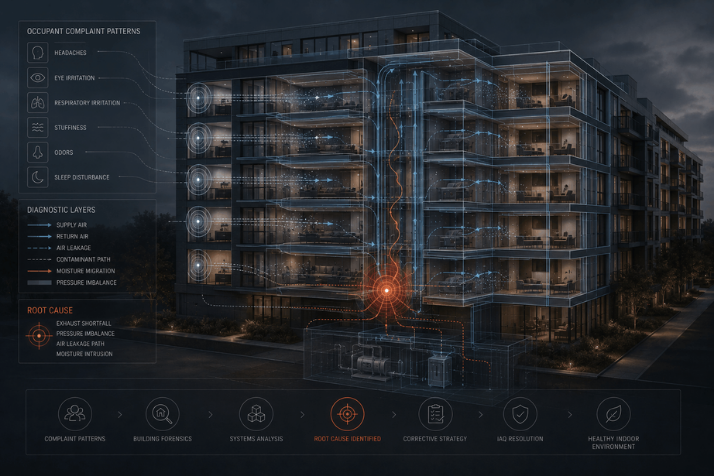
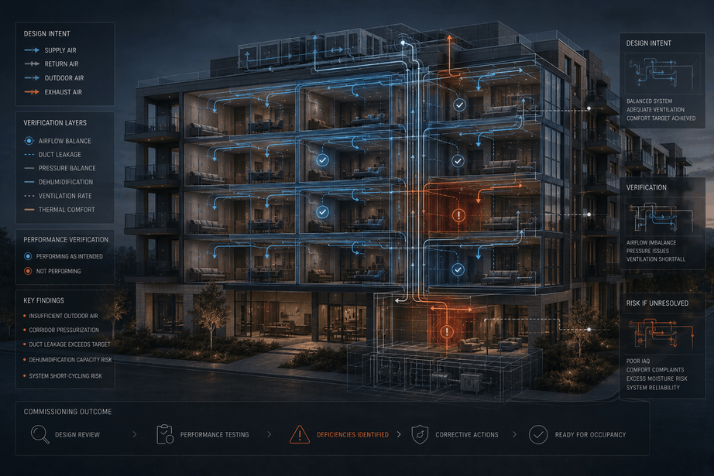
A building science pre-acquisition assessment identified latent moisture intrusion, envelope defects, and mechanical design flaws that a standard property condition assessment had missed — before capital was deployed.
.png)
Whether you're evaluating a vendor proposal, investigating recurring building issues, planning a capital project, or assessing a new acquisition, we'll help determine the right next step.
This narrative describes a common engagement pattern encountered in pre-acquisition building science assessments. It is presented as a representative scenario to illustrate the diagnostic value and transaction protection this engagement provides. Specific client and property details are confidential.
An investor group was completing due diligence on a multifamily acquisition. A standard property condition assessment had been performed. The PCA identified deferred maintenance items and provided capital reserve estimates, but did not include any performance-based testing of the building envelope, mechanical systems, or moisture dynamics. The buyer engaged Building Science Advisors for a building science pre-acquisition assessment before closing.
No visible failures at the time of assessment. The building appeared well-maintained. The presenting risk was not a known problem — it was the unknown. Standard inspections are visual. They establish what exists. They do not establish whether what exists is working or failing invisibly.
In multifamily acquisitions, latent building science failures — moisture infiltration that has not yet produced visible mold, mechanical systems that are oversized and short-cycling, envelope breaches that are admitting water vapor behind the cladding — do not appear in a PCA. They appear in the CapEx budget twelve to thirty-six months after closing, when the warranty period has expired and the seller is no longer at the table.
Building Science Advisors conducted blower door envelope tightness testing, thermal imaging of high-risk wall and roof assemblies, moisture mapping at parapets, window perimeters, and below-grade transitions, HVAC system performance measurement against the design load, air pressure mapping of corridors and units, and an IAQ baseline assessment. All findings were transmitted to The Lab for interpretation and risk-ranking.
Performance-based testing consistently surfaces failures that visual inspection cannot find: envelope assemblies that are technically intact but admitting vapor; HVAC systems that are cooling the space but not dehumidifying it; pressure conditions that are drawing humid air into wall cavities. These are the failures that generate the largest post-closing capital events — and they are invisible to a standard PCA.
In pre-acquisition engagements, the Corrective Action List serves a different purpose than in a remediation context. Each finding is risk-ranked by estimated capital exposure. The owner uses this ranking to structure transaction negotiations: price renegotiation, escrow holdbacks, seller disclosure obligations, or in cases of significant latent exposure, deal reconsideration. The assessment converts unknown risk into quantified, negotiable terms.
For acquisitions where the buyer proceeds and corrective work is required, Building Science Advisors can return post-closing to commission the corrective outcome. The pre-acquisition report establishes the baseline. The post-correction commissioning confirms resolution. The owner has a documented record from day one of ownership.
The most expensive building science problem is one that was present before closing and not identified until after. A pre-acquisition building science assessment converts that risk from unknown and unpriced to known and negotiable. The cost of the assessment is a fraction of the exposure it identifies — and the smallest line item in any acquisition that goes wrong without it.
Contact Building Science Advisors to discuss pre-acquisition due diligence before your next closing.