.png)

The most expensive pattern in multifamily building management is the recurring IAQ complaint. Tenant reports air quality issues. Management dispatches a remediation company. The visible contamination is treated. Six to twelve months later, the complaint returns. The cycle repeats. Each iteration costs capital. Each failed remediation cycle strengthens a tenant’s legal position. And the underlying condition that is generating the complaints continues to damage the building while the owner pays for surface-level responses to it. This pattern is not a remediation failure. It is a diagnosis failure.
Recurring IAQ complaints carry three distinct cost categories that compound with each cycle. The first is direct remediation expenditure. The second is legal exposure: each remediation that fails to resolve a complaint adds to the documentation trail demonstrating that the owner was aware of the problem and unable to fix it — which is the factual basis of most multifamily IAQ habitability claims. The third is tenant churn, which in units with documented IAQ complaint histories accelerates vacancy, reduces achievable rents, and affects the asset’s performance metrics. The financial question is not what the next remediation cycle costs. It is what the unresolved underlying condition will cost across all three categories over the next two to three years.
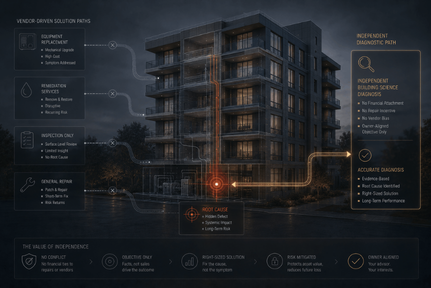
The standard response to an IAQ complaint is testing followed by treatment. IAQ sampling identifies what is present — elevated mold spore counts, above-threshold particulates, detectable VOCs. The remediation treats what the sampling found. The problem is that standard IAQ testing tells you what is in the air. It does not tell you why it is there. An elevated spore count tells you contamination exists. It does not tell you whether the source is the HVAC system, the building envelope, the duct system, or a moisture condition in the wall assembly. Without that root cause finding, any remediation is guesswork — directed at the visible symptom while the invisible cause continues operating.
A systems-level IAQ investigation combines air quality measurement with building science diagnostics to identify not just what is present but why. This means pairing IAQ sampling with blower door testing and air pressure mapping to understand whether the contamination source is being distributed through the mechanical system; HVAC performance assessment to determine whether the system is conditioning the space adequately or creating moisture conditions that feed contamination; moisture investigation to identify whether there are water intrusion pathways or condensation conditions feeding mold growth in the building assembly; and duct system evaluation to assess whether the distribution system itself is a contamination source or pathway. The finding from this integrated assessment identifies the mechanism — the specific combination of building conditions that is producing the IAQ complaint — rather than the symptom.
Before approving another remediation scope on a building with a recurring IAQ complaint, require two things. First, a root cause finding: a documented identification of the specific mechanism producing the contamination, supported by diagnostic instrument data rather than visual assessment. If the remediating company cannot provide a root cause finding supported by building science diagnostics, the scope they are proposing is treating the symptom. Second, an independent clearance protocol: post-remediation clearance testing must be performed by a party with no financial relationship to the remediating company. The testing and the remediation cannot come from the same firm. That independence is the only way to know whether the remediation actually resolved the condition.
Recurring IAQ failures have a common cause: the diagnosis stopped at the symptom. Elevated spore counts are a result. Mold growth is a result. The result can be cleaned repeatedly without resolution if the mechanism producing it is not identified and corrected. A building that has been remediated twice for the same complaint is a building whose cause has not been found. An independent building science investigation finds the cause — and the corrective scope that addresses it breaks the cycle.
Building Science Advisors provide integrated IAQ and building science investigations for multifamily owners, property managers, and asset managers. Contact us when the complaint keeps returning.