.png)

The multifamily insurance market has shifted materially in recent years. Premiums have risen sharply for assets with loss history, deferred maintenance indicators, or documented moisture and water damage events. In some markets, coverage has become difficult to secure at any price for assets that cannot demonstrate active building performance management. Against that backdrop, documented building health is no longer just an operational concern. It is an underwriting factor — and owners who understand this are beginning to use building science assessments as a tool in the insurance conversation, not just the maintenance conversation.
Insurance premium is a fixed operating cost. For a multifamily portfolio, even a modest per-unit premium reduction across a large asset base represents meaningful NOI improvement. More significantly, assets that can demonstrate documented building health may have access to better coverage terms, lower deductibles, or more favorable placement with carriers that are tightening their multifamily books. Conversely, assets that present to underwriters with undocumented moisture history, unresolved IAQ complaints, or no documented maintenance and commissioning records are increasingly finding themselves in high-risk pools with correspondingly high premium structures.
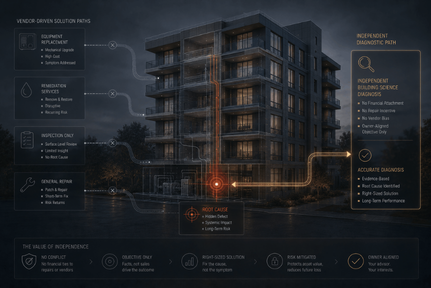
Most multifamily owners approach insurance renewal as a financial negotiation. The conversation focuses on loss history, coverage limits, and broker relationships. What is rarely brought to that conversation is technical documentation of the building’s actual condition and performance — documented envelope tightness, verified HVAC performance, moisture baseline data, and a record of commissioning and corrective action. This documentation exists in buildings where a building science assessment has been conducted. It does not exist in buildings where the only record is maintenance work orders and vendor invoices. Carriers and their underwriters can read the difference.
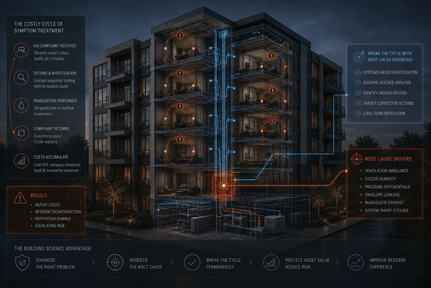
A building science assessment produces the category of documentation that is most relevant to an insurance underwriting conversation: performance-based evidence of building condition rather than age-based estimates of condition. Blower door testing produces a documented envelope tightness rating. Moisture mapping produces a baseline of the building’s moisture condition at a point in time. HVAC commissioning produces a documented record of system performance. Post-corrective commissioning produces evidence that identified deficiencies were resolved. Collectively, this documentation tells a carrier’s underwriter that the building is actively managed to a performance standard — which is a fundamentally different risk profile than a building that is managed reactively to reported failures.
If your portfolio is approaching an insurance renewal and you are aware of assets with moisture history, IAQ complaints, or deferred maintenance, consider commissioning a building science assessment before the renewal conversation with your broker. The assessment creates two potential advantages. First, it may identify and allow you to correct conditions that would otherwise present negatively in the underwriting review. Second, it produces documentation that can be presented to the carrier as evidence of active building performance management. Discuss with your broker whether building science assessment documentation is relevant to your specific carrier relationships and coverage structure.
Building science assessment documentation is not produced for insurance purposes — it is produced because understanding building performance is how asset managers protect capital and manage risk. The fact that it is also useful in insurance conversations is a secondary benefit of doing the diagnostic work correctly. An asset with a documented performance baseline, a record of corrective action, and a commissioning certificate presents differently than an asset without those records — and the difference is visible to anyone reading the file, including the underwriter.
Building Science Advisors provide building science assessments and commissioning documentation for multifamily assets. Contact us to discuss how documented building health fits into your asset management and insurance strategy.