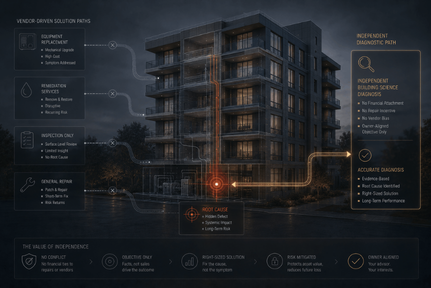
If your building has a chronic humidity problem and an HVAC contractor’s answer is a new system, there is a reasonable chance you are being offered a solution to the wrong problem. Equipment replacement is the contractor’s highest-margin recommendation. It is also, in many multifamily humidity failures, the recommendation that perpetuates the problem rather than resolving it. Here is why.
Unresolved humidity problems in multifamily buildings generate a predictable chain of costs. Elevated relative humidity above threshold levels creates conditions for mold growth. Mold generates tenant complaints. Tenant complaints generate remediation events. Remediation events consume capital. If the humidity condition that caused the mold was not addressed, the mold returns and the cycle repeats — with the owner absorbing the cost of each iteration. The financial question is not how much a new HVAC system costs. It is how many remediation cycles the humidity problem will generate if the HVAC system is not the actual cause.
Most asset managers review HVAC replacement proposals as mechanical decisions: is the equipment at end of life, is the proposed system appropriately specified, is the price competitive. These are reasonable questions. The question that is almost never asked is whether the HVAC system is actually the source of the humidity problem. In many multifamily buildings, particularly in high-humidity climate zones, the answer is no. The HVAC system is operating exactly as designed. The problem is that it was designed incorrectly — or that the building envelope, pressure dynamics, or ventilation system is the primary driver of the humidity load, not the mechanical equipment.
The central question in any multifamily humidity investigation is: where is the moisture coming from? There are three potential sources. First, the mechanical system may be oversized — a system that is too large for the space it conditions will satisfy the thermostat quickly and shut off before completing a full dehumidification cycle, a pattern called short-cycling. The space cools but does not dry. Second, the building envelope may be admitting moisture — negative pressure conditions, envelope breaches, or inadequate vapor management can introduce more moisture than any correctly sized mechanical system can remove. Third, the ventilation system may be introducing unconditioned humid air into the space without adequate treatment. Each of these requires a different correction. An HVAC replacement addresses none of them if they are the actual cause.
Before approving an HVAC replacement scope on a building with a humidity complaint, request three pieces of documentation. First, a Manual J load calculation establishing the actual heating and cooling load of the space and confirming that the proposed equipment is sized to that load rather than the existing equipment. Second, a building pressure survey confirming whether the affected spaces are under positive or negative pressure relative to adjacent spaces and the exterior. Third, an assessment of the ventilation system confirming that fresh air delivery is conditioned or managed before entering the occupied space. If the contractor proposing the replacement cannot provide these three documents, the scope is not analytically supported.
An HVAC system that is correctly sized, correctly installed, and correctly commissioned will remove both sensible heat and latent moisture from the space it conditions. An oversized system will remove heat efficiently and leave moisture behind. The difference between those two outcomes is a load calculation performed before equipment selection — a step that most replacement contractors skip. An independent building scientist performs that calculation before any equipment recommendation is made, and designs the solution to the actual problem the building has, not the problem that justifies the highest-margin replacement scope.
The Building Scientist provides independent mechanical assessment and HVAC design services for multifamily owners and asset managers. Contact us before approving your next HVAC replacement scope.