Every year, multifamily owners and asset managers approve remediation and mechanical scopes that are larger than necessary, misdirected at the wrong problem, or both. The vendors proposing those scopes are not always acting in bad faith. They are acting in their financial interest — which is structurally different from yours. Understanding that difference is the first step to protecting your capital before the next scope lands on your desk.
A remediation scope that addresses the wrong problem does not stay wrong quietly. It fails visibly. The mold returns. The humidity persists. The tenant complaints resume. And by the time the second remediation cycle begins, the owner has paid for two scopes, neither of which solved the actual problem. The compounding cost is not just the direct expenditure — it is the legal exposure that accumulates with each failed cycle, the tenant displacement, the insurance implications, and the deferred resolution of a condition that is continuing to damage the building while the owner pays for ineffective treatment.
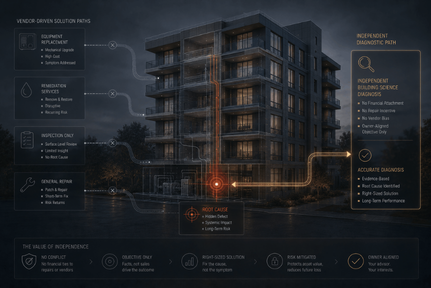
The most common error in reviewing a remediation scope is treating it as a technical document rather than a commercial one. A scope submitted by a remediation company is a bid. It reflects what the company can perform and what it is willing to charge — not necessarily what the building requires. The four patterns that signal an inflated or misdirected scope are: demolition proposed without a documented root cause finding; HVAC replacement recommended as a humidity solution without a Manual J load calculation; post-remediation clearance testing to be performed by the same company doing the remediation; and no air pressure mapping of the affected space anywhere in the diagnostic record.
An independent scope review examines the vendor’s proposal against the building’s actual condition. The first question is not whether the scope is priced fairly — it is whether the scope addresses the actual cause. A forensic building scientist reviews: whether the proposed demolition extent is supported by moisture data or based on visual assessment alone; whether the HVAC recommendation is supported by performance measurement or based on equipment age; whether the duct system has been tested or assumed to require replacement; and whether the pressure condition of the building has been documented, since in most multifamily moisture and mold failures, building pressure dynamics are the primary driver and are almost never assessed by the remediating vendor.
Before approving any remediation or mechanical scope above your capital review threshold, take three steps. First, confirm that the scope identifies a specific root cause — not just a visible symptom. If the vendor cannot state what is causing the moisture condition that is producing the mold, the scope is treating the result of the cause, not the cause itself. Second, confirm that the post-remediation clearance testing will be performed by a party with no financial relationship to the remediator. This is not a formality — it is the only way to know whether the remediation actually worked. Third, engage an independent building scientist to review the scope before it is approved. The cost of the review is a fraction of the scope it is reviewing.
The question to ask before signing any remediation scope is not “is this vendor reputable?” It is “who identified the root cause, what was it, and does this scope address it?” If those three questions cannot be answered clearly from the documents in front of you, the scope is not ready for approval. An independent forensic assessment and scope review provides the answers — and the documentation to support whatever capital decision follows.
The Building Scientist provides independent scope review and forensic diagnostic services for multifamily owners, asset managers, and REITs. Contact us before your next capital approval.