.png)

A property condition assessment is a useful document. It establishes the age and condition of major building systems, estimates deferred maintenance, and provides a capital reserve projection. It does not tell you whether the building is actively failing. There is a difference between those two things, and that difference often represents the largest line item in a value-add acquisition’s first-year capital budget.
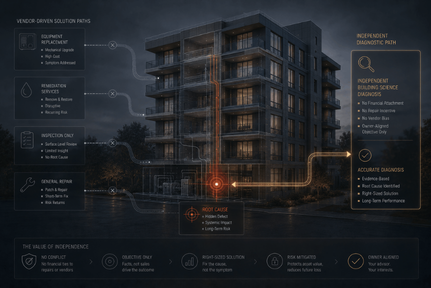
The most expensive building failures in multifamily acquisitions are not the ones you can see. They are the ones that are present at closing, invisible to a standard inspection, and fully visible — and fully your problem — eighteen months later. Moisture infiltration that has not yet produced visible mold. An HVAC system that is short-cycling and generating humidity that is migrating into wall assemblies. A building envelope that is admitting water vapor behind cladding that looks intact from the exterior. A ventilation system creating negative pressure that is drawing humid corridor air into units. None of these appear in a PCA. All of them generate significant post-closing capital events.
The standard due diligence process for a multifamily acquisition is well-established: environmental phase one, property condition assessment, financial audit, physical walkthrough. This process is designed to identify known conditions and estimate known capital needs. It is not designed to identify latent performance failures — conditions that are present and active but not yet visible. The result is that acquisitions regularly close with building science failures that were present at the time of purchase and simply not detected by any of the standard due diligence instruments.
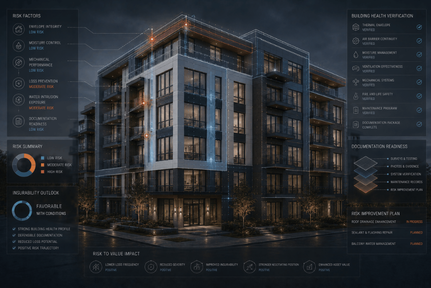
A building science pre-acquisition assessment uses performance-based instruments to measure what the building is doing, not just what it looks like. This includes blower door testing to measure actual envelope tightness and identify infiltration pathways; thermal imaging to locate moisture and thermal bridging in wall and roof assemblies; moisture mapping at high-risk transition zones including parapets, window perimeters, balcony connections, and below-grade walls; HVAC performance measurement against the actual load calculation rather than nameplate specifications; air pressure mapping across corridors, units, and common areas; and an IAQ baseline that establishes what is in the air before the asset changes hands. Each of these measurements produces data that a visual inspection cannot produce, because the conditions being measured are invisible to the eye.
For any multifamily acquisition above a threshold that justifies the due diligence investment, add a building science assessment to the standard PCA. The assessment should be scoped to the specific risk profile of the asset: a high-humidity climate zone warrants moisture and pressure investigation; a recently constructed building warrants envelope tightness and commissioning verification; an older garden-style asset in the Southeast warrants duct leakage and envelope testing. The findings from the assessment feed directly into transaction structuring — price negotiation, escrow holdbacks, seller disclosure requirements, and go or no-go decisions. The assessment converts unknown risk into negotiable terms.
A property condition assessment tells you what a building has. A building science assessment tells you whether what it has is working. Both are due diligence instruments. For a multifamily acquisition in a climate zone where building envelope performance, moisture dynamics, and HVAC design have material impact on operating costs and tenant experience, the building science assessment is the more financially consequential document. The cost of the assessment is always less than the cost of discovering its findings after closing.
Building Science Advisors provide pre-acquisition building science assessments for multifamily investors, REITs, and institutional buyers. Contact us before your next closing.